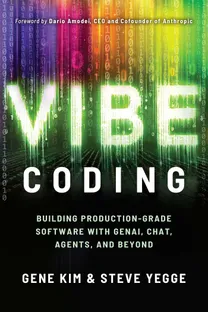
Vibe Coding
Gene Kim & Steve Yegge
Read
The book is mostly an introduction to coding with AI. If you already use agents heavily, you won’t learn much. FAAFO is still a good way to explain the value: fast, ambitious, autonomous, fun, and optionality.
The authors call almost all AI-assisted development vibe coding. I still prefer Agentic Engineering when the human owns the system and its quality.
Start now
Don’t fall prey to the tempting work-deferral trap. Saying “It’ll be way faster in 6 months, so I’ll just push this work out 6 months” is like saying, “I’m going to wait until traffic dies down.” Your drive will be shorter, sure. But you will arrive last.
Steve Yegge
FAAFO
FAAFO names five benefits of coding with AI:
- Fast. Shorter feedback loops. Small jobs now take minutes.
- Ambitious. One person can build things that used to need several specialists.
- Autonomous. Fewer handoffs and less waiting on other teams.
- Fun. More building, less fighting the tools.
- Optionality. Try several approaches and throw away the ones that don’t work.
Speed makes the other four possible.
I want to highlight that, with agents, you’re able to parallelize more. That often means greater speed, but I’m finding that there are still bottlenecks that slow down each independent feature or product. So while each is faster to build, you’ll also notice that you’re simply able to do more experiments than ever before.
Easier to fix than file
AI makes the “easier to fix than file” category much bigger. I do this all the time. But being able to fix something quickly doesn’t mean you should.
Autonomy
Agents let domain experts build the thing instead of explaining the full picture to a developer. This is a wonderful benefit to AI - so many people have ideas, but not the ability to bring them to life. Now they do.
The fundamentals still matter
Superior pilots use their superior judgment to avoid situations which require the use of their superior skill.
Frank Borman