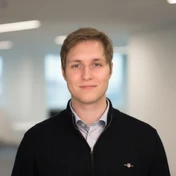
Hi, I’m Christian
A software engineer from Denmark building tools for thought and helping thousands work smarter.
I write and create videos about building software and tools for thought.
What drives me
I want to make the future better.
I believe problems are soluble. The future can be genuinely better. We can accelerate innovation, solve hard challenges, raise the ceiling on what’s possible. Not through naive optimism, but through people willing to create, contribute, and share.
That’s why I build tools and share what I learn. Every tool built, concept explained, problem solved adds to our collective understanding and accelerates progress. When you share knowledge freely, you create equality of opportunity. That’s how we make the future better.
My curiosity across computer science, mathematics, physics, biology, psychology, and philosophy serves this directly. Broad interests aren’t a distraction; they’re an edge. They enable pattern recognition across domains. They reveal connections specialists miss. They let you solve problems by borrowing ideas from one field and applying them to another. Mental models compound.
“If I had to tell you exactly what I do, I’d tell you that I do my best every day to become the best version of myself that I can become.”
For me, that means being useful. Creating things that help people work smarter, think better, accomplish more. When a tool improves someone’s workflow, when writing makes a complex idea click, when a project helps someone be more productive: that’s the point.
Through my work on QuickAdd (opens in a new tab) and MetaEdit (opens in a new tab), and other projects with over 2.5 million combined downloads, I’ve experienced something incredible: building things that improve people’s lives is deeply rewarding. The thrill of creating value that actually helps someone; I want that to continue.
The internet provides freely accessible knowledge to everyone. That’s beautiful. More people sharing what they know, contributing to the total sum of human knowledge: that’s how we accelerate progress and build the future we want to see.
How I work
Everything I do is built on one insight: there’s only one skill that truly matters: problem-solving. Every other skill is just applied problem-solving with different tools.
This changes how you approach learning and work. Instead of collecting tools and technologies, you hunt for fundamentals, the 80/20 concepts that everything else is built upon. Once you have the fundamentals of a field and strong meta-problem-solving skills, you can tackle basically any problem in that domain.
Most people don’t touch enough fields to recognize how much transfers between them. But those who do (Feynman across physics and biology, Musk across physics and engineering and business) apply it systematically. The patterns repeat. The mental models compound.
This requires building what Charlie Munger called a “latticework of mental models.” As he put it: “You can’t really know anything if you just remember isolated facts and try and bang ‘em back. If the facts don’t hang together on a latticework of theory, you don’t have them in a usable form.”
Mental models are reusable patterns of thinking: algorithms for solving categories of problems. Systems thinking. First principles reasoning. Probabilistic thinking. Incentive structures. The Pareto principle. These transcend any single domain. When you have the right models, experience compounds instead of just accumulating.
But mental models alone aren’t enough. As Feynman said: “What I cannot create, I do not understand.” I don’t just use tools; I understand what’s happening under the hood. Not to show off, but because deeper understanding is a force multiplier. It enables better debugging, more creative solutions, and the ability to build new tools when existing ones fall short.
Here’s where it gets interesting. Each new domain you explore doesn’t just add knowledge; it adds perspective. This is information arbitrage: leveraging knowledge from one context to create value in another. The most powerful innovations often come from applying principles from one domain to problems in another, precisely because most specialists never make that connection.
This approach compounds exponentially. Each mental model you build makes the next one easier to grasp. Each domain you explore reveals patterns in previous domains. Each problem you solve expands your toolkit for future problems. After a decade of this, you’re not just ten years more experienced; you’re operating with a fundamentally different capacity to see and solve problems.
The goal isn’t to know every language or framework. It’s to understand fundamentals, recognize patterns, grasp principles, and master the meta-skills of learning, thinking, and problem-solving. That’s what creates unique value.
Selected projects
- QuickAdd ~2,000 stars Powerful Obsidian plugin for quick capture and automation. Helps thousands of knowledge workers streamline their note-taking workflows. (opens in a new tab)
- Tools for Thought 2,800+ stars Built 5 Obsidian plugins including MetaEdit, PodNotes, and NoteTweet: a comprehensive ecosystem for knowledge management. (opens in a new tab)
- PodNotes ~250 stars Obsidian plugin for podcast note-taking that helps users capture insights from audio content efficiently. (opens in a new tab)
- AI Development Tools Tools like claude-github-triage and auralite, exploring how AI can enhance developer workflows and productivity. (opens in a new tab)
Contributing to Mars exploration
For my master’s thesis at Aalborg University, I worked with NASA’s ChemCam and SuperCam instruments on the Curiosity and Perseverance Mars rovers. Our team developed advanced machine learning methods to predict major oxide compositions in Martian rock and soil using laser-induced breakdown spectroscopy (LIBS) data.
We systematically explored 12 different ML models and built an automated optimization framework using Optuna to tackle the unique challenges of LIBS data: high dimensionality, multicollinearity, and limited samples. Our stacking ensemble methodology achieved a 24–34% improvement over baseline prediction accuracy.
These contributions stand to make a sizeable impact on the field of chemometrics as applied to the ChemCam and SuperCam emission spectroscopy instruments on two active missions as part of NASA’s Mars Exploration Program.
Dr. Ryan B. Anderson & Dr. Travis S.J. Gabriel, USGS Research Physical Scientists
Key contributions
- Stacking Regressor approach. Automated alternative to the existing submodel blending method in ChemCam calibration.
- Direct code contributions to PyHAT. Parallelized ChemCam data reading, automated outlier identification (previously manual and tedious), ICA loadings interpretation.
- Comprehensive model catalog. Systematic evaluation of ML models and preprocessing techniques for predicting major oxide compositions.
Let’s stay connected
Sharing what I’m learning, building, and shipping. No spam, ever. Unsubscribe at any time.
Thank you for subscribing.
You’ll receive an email confirmation shortly.